A shaking steering wheel and pulsating brake pedal on a 2011-2014 Honda Odyssey are commonly diagnosed as front rotor thickness variation. Heat causes uneven spots on the rotor face; those spots push back through the caliper into the pedal and steering column every time you slow down. The main causes are heat-stressed rotors, glazed pads, and sticky caliper slide pins. Replacement rotors and pads, properly bedded in, are the standard fix.
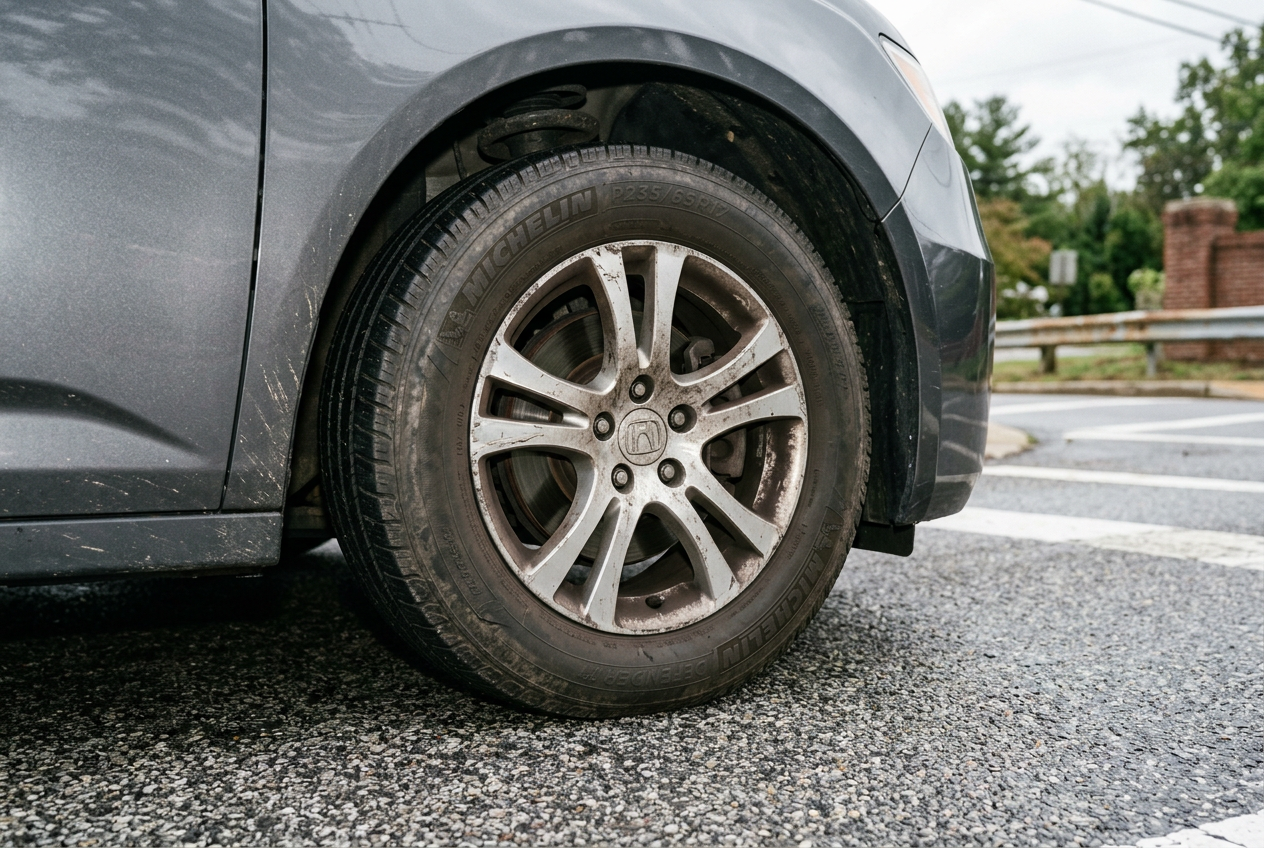
Rendered image of a 2011-2014 Honda Odyssey. Not a customer vehicle.
Which Odyssey years have this problem?
This brake pedal pulsation and steering wheel shake pattern is commonly reported on roughly 2011-2014 Honda Odyssey minivans. If your Odyssey falls in that range and you feel the shake when slowing from expressway speed, the front rotors are the first place to look. Check your VIN at nhtsa.gov/recalls to confirm whether any open recall applies to your specific vehicle.
What exactly causes the steering wheel to shake when braking?
The front brake rotors on the 2011-2014 Odyssey are commonly diagnosed as developing thickness variation after repeated heat cycles. When a rotor is not perfectly uniform in thickness, the caliper piston gets pushed in and out as the rotor turns. That movement travels up through the steering knuckle and into the steering wheel. You feel it as a rhythmic pulse or shake that gets worse as speed increases.
Caliper slide pins that are dry or corroded make the problem worse. A sticky pin keeps the inboard pad pressed lightly against the rotor even when you are not braking, which generates extra heat and accelerates uneven wear.
Why does the shake come back after the rotors are resurfaced?
Resurfacing (also called turning or cutting) removes a thin layer of metal to restore a flat surface. The problem is that each pass leaves the rotor thinner. A thinner rotor holds less heat, reaches higher temperatures faster, and warps sooner. On a 2011-2014 Odyssey, a resurfaced rotor often returns to pulsating within a season, especially with Chicago’s heavy road salt use and freeze-thaw cycle eating at the rotor from the outside in.
Replacement rotors start at full thickness and give the system a proper heat margin. Paired with new pads and a correct bedding procedure, they are the repair that actually holds.
How does the symptom progress if you ignore it?
Stage
What you notice
Likely condition
Urgency
Early
Mild steering wheel shimmy from 60-65 mph when braking; goes away at low speed
Minor rotor thickness variation, pads still serviceable
Schedule within 2-4 weeks
Mid
Noticeable pedal pulse at any highway speed; shimmy felt in the seat
Moderate thickness variation; pads may be glazed
Schedule this week
Late
Hard pedal pulsation even at 35-40 mph; longer stopping distances; possible grinding
Severe rotor wear; pads likely at or past minimum thickness
Do not delay; inspect immediately
Is it safe to keep driving your Odyssey with a pulsating brake pedal?
At the early stage, short low-speed trips carry lower risk, but the condition will worsen. A pulsating pedal means braking force is uneven across the rotor face. In a hard stop or an emergency, that unevenness can extend your stopping distance or pull the van to one side. Chicago road salt and moisture also accelerate rotor corrosion, which means a rotor that feels borderline in October can deteriorate faster than you expect through winter. Do not wait until you hear grinding.
What does the repair involve?
Remove the front wheels and calipers.
Measure rotor thickness at eight points around the face. If variation exceeds 0.001-0.002 inches, replacement is the correct call.
Inspect caliper slide pins for corrosion or binding. Clean, lubricate, or replace as needed.
Measure lateral runout with a dial indicator to confirm the hub face is true before installing the new rotor.
Clean all rust and scale off the hub face so the new rotor sits flat. Rust buildup on the hub face is a leading reason new rotors develop pulsation again, and Chicago road salt makes that buildup worse than in drier climates.
Install new front rotors and new brake pads.
Torque lug nuts to spec (80 ft-lb) in a star pattern.
Perform a proper bedding sequence: 8-10 moderate stops from 30 mph with cooling time between each stop.
What does this repair cost, and what moves the price?
There is no single number without seeing the vehicle, because several variables affect the total. Here is what moves it:
Rotor grade: Economy rotors cost less upfront but may not last as long on a heavier vehicle like the Odyssey. OEM-spec or premium rotors carry a higher parts cost but typically hold up better through Chicago winters.
Pad compound: Ceramic pads cost more than semi-metallic but produce less dust and often run cooler.
Caliper condition: If the slide pins are seized or a caliper piston is sticking, that adds parts and labor.
Front only vs. all four corners: If the rear pads are also near the end of their life, combining the service saves labor time overall.
For an honest estimate on your specific Odyssey, bring it in for an inspection. A visual check and a rotor measurement take about 20 minutes and give you real numbers to work with. Norwood Auto Service backs brake repairs with a 3-year / 36,000-mile nationwide warranty, so the work is covered whether you are driving in Norwood Park or on a road trip.
Two members of the Norwood Auto Service team, outdoors.
How Norwood Auto Service confirms the diagnosis
Erik Scheidt, owner and leader of our ASE Certified technician team, starts with a micrometer measurement of rotor thickness at multiple points around the face. That reading tells us whether the rotor is within spec or has developed the variation causing your shake. We also check caliper slide pin movement and pad thickness before quoting anything. You get a written estimate before any work begins, and we walk you through what we found. Financing is available if the repair is larger than expected, and complimentary Uber rides (up to 3 miles) are available while your van is in the bay.
You can also check whether any open recall applies to your VIN directly at nhtsa.gov/recalls, and review your ownership documents at owners.honda.com.
Why does my Odyssey steering wheel shake only when I brake from highway speed?
At higher speeds the front rotors spin faster, so even small thickness variations create a noticeable pulse through the pedal and steering wheel. At low speeds the same variation is too small to feel.
Will resurfacing the rotors fix the shake for good?
Usually not on a 2011-2014 Odyssey. Resurfacing removes material and leaves thinner rotors that heat up faster and develop thickness variation again sooner. Replacement rotors are the more durable repair.
Is it safe to keep driving with a pulsating brake pedal?
Short trips at low speed carry lower risk, but a pulsating pedal means your stopping power is uneven. Highway driving or emergency stops are where that becomes dangerous. Get it inspected promptly.
Do I need to replace the brake pads at the same time?
Yes. New rotors should always be paired with new pads. Old pads carry a wear pattern from the old rotor surface and will transfer uneven deposits onto the new rotor quickly.
What is the proper way to bed in new brake rotors and pads?
After installation, perform 8-10 moderate stops from about 30 mph, allowing the brakes to cool between each stop. This transfers a thin, even layer of pad material onto the rotor surface and helps prevent early warping.
Ready to stop the shake? Book a brake inspection at Norwood Auto Service. Erik Scheidt and the ASE Certified team will measure your rotors, check the calipers, and give you a straight written estimate. The shop is at 6055 N Northwest Hwy in Norwood Park, Chicago. Hours are Monday, Tuesday, and Thursday 8am-5pm; Wednesday 9am-5pm; Friday 8am-4pm.
Erik Scheidt is the owner of Norwood Auto Service and represents the second generation of family leadership at the shop. He began working at Norwood Auto Service at age 16 and now brings more than 18 years of hands-on experience in every aspect of the automotive business, from customer service to shop management.
Today, Erik leads a team of ASE certified technicians dedicated to providing high quality repair and maintenance for both domestic and foreign vehicles. He has helped modernize the shop by introducing Digital Vehicle Inspections, giving customers photos, detailed explanations, and the information they need to make confident decisions about their vehicles.

 Call Us: (773) 774-7333
 Address: 6055 N Northwest Hwy, Chicago, IL 60631, USA
 Open Hours: Mon-Thu 8AM-5PM (Wed opens 9AM) Fri 8AM-4PM






1 Comment:
Comments are closed.